Theo and Malthios Reconcile
The Reincarnated Demon King's Host Just Wants to Live in Peace, But the Hero Won't Leave Him AloneTheo and Malthios reconcile in a secluded ravine, where a confession breaks through years of coercion and resentment. Malthios’s admission that he fears losing Theo changes the meaning of their shared body: it is still a prison in important ways, but it is also the place where two mutually dependent lives have become emotionally bound.
The Conflict Behind the Reconciliation
Their relationship began under conditions neither had chosen. Theo was the Demon King’s host, while Malthios was confined within Theo’s mind and body; each could know the other’s thoughts and feelings. Theo’s resistance was not presented as principled defiance: he refused Malthios’s suggestions because he saw no point in them and hated being told what to do. Malthios responded with threats and insults, and his fits brought on headaches so severe that Theo became bedridden. The hostility could not simply be escaped: Malthios explained that transferring himself to another host would require years of preparation, and that Theo’s death would kill them both.
That history makes the ravine encounter more than a sudden declaration of affection. By then, Malthios’s presence has continued to weigh on Theo: his persistence has disrupted Theo’s sleep and caused headaches, while Theo’s nightmares about Luc’s bloodied, broken body add another strain. Later, Luc recognizes the cost of Theo’s return to the Hero’s Party, saying that Theo had fled to escape control and was now being dragged back against his will. Their shared history is therefore marked both by intimate knowledge and by the danger of one person’s power over the other.
The Ravine and the Confession
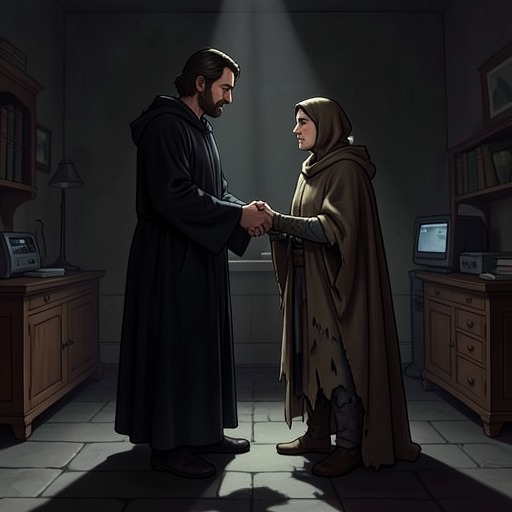
After Luc’s party departs, Theo walks past his shop and follows a stream to a waterfall. He crosses the slippery rocks, passes behind the falls, and enters a hidden ravine, where he sits beside a rocky pool and looks at his reflection. There, he says Malthios’s name and loosens his control. Malthios’s mana floods through him as black eyes with red slits, ebony horns, dark red feathered wings, and an arrow-pointed tail appear. The transformation is both exhilarating and frightening: Theo experiences Malthios’s power filling him, while his reflection smiles without his command.
Malthios first asks whether Theo has been plotting, then claims that he wanted Theo to enjoy himself. Theo distrusts the explanation and calls him a liar when Malthios says he cares. Malthios answers that their thoughts and emotions are shared, so he cannot lie to Theo. When Theo calls himself Malthios’s prison, Malthios’s answer is not another threat but a confession: “You’re all I have!” The words echo through the ravine and through Theo’s chest, making the place of their confrontation an intimate setting for a truth neither had previously acknowledged so plainly.
Shared Loss, Protection, and Jealousy
Malthios explains that he once had friends, and that a Hero’s blade killed them. Their deaths led to the actions that culminated in his ascension as Demon King. He had believed his capacity for feeling died with them, but Theo reminds him of those lost companions and makes him want to protect someone again. Malthios describes the impulse as resembling the care of an older brother: he wants Theo safe and happy, and tried to turn him away from the Hero because he feared the Hero would hurt him.
Protection, however, is not his only motive. Malthios also admits that he was jealous. The two had been alone together for so long that he did not want Theo to leave him. His admission complicates his earlier attempts to direct Theo: concern for Theo’s safety was real, but so was possessiveness. Theo answers that he cannot leave Malthios because they are stuck with each other. Malthios accepts the bond rather than resisting it, saying he would not have it any other way. He also credits Theo with showing him parts of the world he had dismissed as pointless, and asks Theo not to lie to the person he loves. Theo does not promise to settle that question immediately; he says they will cross that bridge when they reach it and redirects their attention to the present.
What Reconciliation Changes
The encounter does not undo the coercion that shaped their relationship, nor does it make their shared existence simple. Its decisive change is that Malthios’s attachment becomes explicit and reciprocal in a new way: Theo can name their mutual confinement, and Malthios can acknowledge both his fear and his jealousy without turning either into a threat. The physical transformation gives that recognition a visible form, but Theo retains control while drawing on Malthios’s power; the scene presents proximity and difference together rather than dissolving one into the other.
That bond matters again when Theo breaks the barrier holding him and throws himself between Tyraz’s raised sword and Luc. With no plan or weapon, Theo acts to save the man he loves and calls inwardly to Malthios; Malthios answers, “I’ve got you, Theo.” The moment carries their earlier exchange into action: Malthios’s power supports Theo without taking his control away. In the later trial, Luc chooses to delay killing the Demon King, and the verdict sentences Malthios to life in prison while freeing Theo of all charges. Their reconciliation does not settle the political or moral consequences of Malthios’s past, but it establishes the emotional bond that will persist through the danger, public judgment, and uncertain future they face together.